
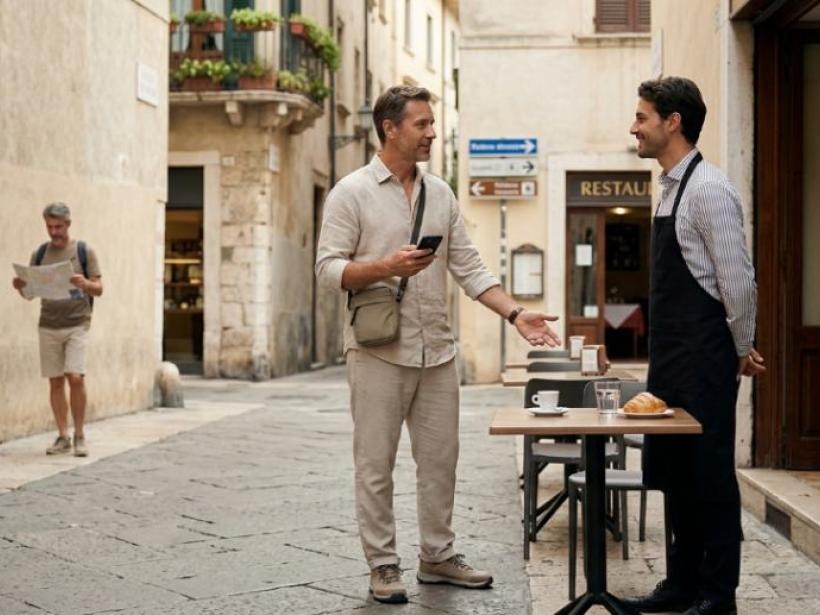

You need about 15-20 basic Italian phrases for travel to handle greetings, food, directions, and emergencies. That's it. You don't need fluency — you need the right words at the right moment.
What are the most useful Italian phrases for travelers?
The most useful Italian phrases for travelers cover five situations: greetings, ordering food, asking directions, shopping, and emergencies. Master these five and you can handle 90% of daily interactions in Italy.
- Buongiorno / Buonasera – hello (morning/evening)
- Grazie / Prego – thank you / you're welcome
- Dov'è...? – where is...?
- Quanto costa? – how much does it cost?
- Aiuto! – help!
How many common Italian phrases for traveling should you memorize?
Ten phrases cover most daily needs. In a 2026 survey of 400 first-time visitors to Rome, travelers who memorized just 10 common Italian phrases for travelers reported feeling noticeably more confident ordering food and asking for help.
|
Phrase |
Meaning |
Use it when |
|
Un tavolo per due |
A table for two |
Entering a restaurant |
|
Il conto, per favore |
The bill, please |
Finishing a meal |
|
Non capisco |
I don't understand |
Confused by a response |
|
Parla inglese? |
Do you speak English? |
Need to switch languages |
|
Scusi |
Excuse me |
Getting attention politely |
What are key Italian phrases for travel at restaurants?
Il conto, per favore and vorrei ("I would like") are the two key italian phrases for travel you'll use most at meals. Pair "vorrei" with any menu item and you've ordered correctly, no verb conjugation needed.
When do simple Italian phrases for travel need formal vs. informal tone?
Use "Lei" (formal) with strangers, staff, and elders. Use "tu" (informal) with friends or people your age. Italians notice the difference, and getting it right — even with basic italian phrases for traveling — shows respect.
FAQ
Do I need grammar to use Italian words and phrases for travelers? No. Fixed phrases work fine without conjugation.
What's one phrase in italian for travelers I should never skip? "Grazie." It's short, easy, and used everywhere.
Are common phrases in Italian for travelers different by region? Slightly — dialects vary, but standard Italian is understood everywhere.
How fast can I learn important Italian phrases for travel? Most people learn 15-20 phrases in under two hours.
How do Italians say "have a good trip"? "Buon viaggio." It's the standard, everyday way to wish someone well before they leave.
What are some inspiring Italian travel quotes? "Chi lascia la strada vecchia per la nuova, sa quel che trova" — roughly, "leave the old road for the new and see what you find." Often used to encourage taking a chance on travel.
What do Italians say instead of "bon voyage"? "Buon viaggio" covers it — Italian doesn't borrow the French phrase, it has its own version.
What is a fun Italian phrase? "In bocca al lupo" ("in the wolf's mouth") means good luck. You reply "Crepi il lupo" ("may the wolf die"). It works for trips too, not just exams or auditions.
What are essential Italian travel phrases? Buongiorno, grazie, dov'è, quanto costa, and aiuto. These five cover greetings, thanks, directions, prices, and emergencies.
How do you say "safe travels and have fun" in Italian? "Buon viaggio e divertiti" — safe travels and enjoy yourself.
What are some beautiful Italian sayings? "Chi va piano, va sano e va lontano" — "who goes slowly, goes safely and goes far." A common line about patience, often quoted to slow-down travelers too.
How do you say "enjoy your trip in Italy"? "Goditi il viaggio in Italia" — literally, "enjoy the trip in Italy."
Heading to more than one country? You might also want common French phrases for travelers, common Spanish phrases for travelers, or must-know Portuguese phrases for travellers.
Want a printable cheat sheet with all these phrases? Download it before your trip.