
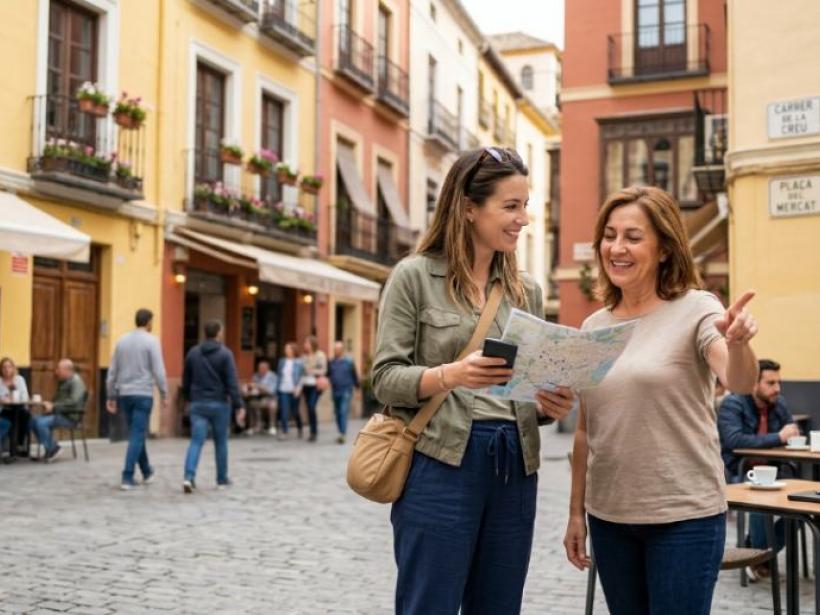

A useful Spanish travel phrase is one a local actually understands in their country. Not the one that's technically correct in a textbook, the one that works on a real person in front of you. Spanish spans 20 countries, and the same word doesn't always mean the same thing depending on where you're standing.
Four situations cover most travel needs. Greeting someone. Asking for help. Asking a price. Finding a bathroom. Learn "disculpe," "¿habla inglés?," "¿cuánto cuesta?," "¿dónde está el baño?," and "muchas gracias." The phrases aren't the hard part, and the same is true if you're comparing notes with Portuguese phrases for travelers before a trip next door. Knowing which words shift by region, that's where people trip.
What Spanish Phrases Do Travelers Need?
Forget memorizing 50 phrases before a trip. A handful, repeated constantly, covers most of what you'll actually need, the same rule that applies to Greek words and phrases too.
|
Spanish |
Meaning |
When to Use It |
|
Disculpe |
Excuse me |
Getting someone's attention politely |
|
¿Habla inglés? |
Do you speak English? |
After trying Spanish first, not instead of it |
|
¿Cuánto cuesta? |
How much does it cost? |
Markets, taxis, anywhere without a price tag |
|
¿Dónde está el baño? |
Where's the bathroom? |
Cafés, bus stations, museums |
|
La cuenta, por favor |
The check, please |
Ending a meal without flagging someone down |
Why Spanish Doesn't Sound the Same Everywhere
Vocabulary isn't the only thing that shifts by country. How Spanish actually sounds changes too, and that quietly wrecks people mid-conversation, even after they've done the work of memorizing the right words.
In Spain, "c" before "e" or "i" and the letter "z" get a lisped "th" sound. "Gracias" comes out closer to "grathias," something you'll hear constantly on a trip to Seville or anywhere else in the country. Cross to most of Latin America, and that same combination sounds like a plain "s," so "gracias" is "grasias" instead. Neither version is more correct, just different standards, and a traveler who learned one can genuinely mishear the other the first few times.
Caribbean and coastal Spanish drops sounds on top of that. Words often lose their final "s," so "más o menos" can come out closer to "má o meno." Not sloppy speech, whatever a textbook implies. A recognized, well-documented regional pattern that phrasebooks rarely warn you about.
The Vocabulary Trap Nobody Warns You About
Here's what most phrase lists never mention. A straw is a "pajita" in Spain, a "popote" in Mexico, a "sorbete" in Argentina. A bus is "autobús" in Spain, "camión" in parts of Mexico, "guagua" in the Caribbean. None of these are wrong, just regional, and a phrasebook built around Spain's Spanish can leave you standing confused if you're following a Mexico City travel guide or wandering Buenos Aires.
If a word doesn't land, don't assume you botched it. Try describing what you mean instead of just repeating the same word louder, a habit almost every traveler falls into without noticing.
Food words shift too. Popcorn is "palomitas" in Mexico, "cotufas" in Venezuela. A sandwich might be a "sándwich," a "bocadillo," or a "torta," depending on the country. Most phrasebooks assume Spain's vocabulary travels unchanged everywhere else. It doesn't, not even close.
Tú, Usted, or Vos: Which One?
Use "usted" with strangers in most countries, and you'll rarely go wrong. The formal "you," similar to French "vous," and it signals respect at no real cost.
Argentina and parts of Central America complicate this with "vos," a second informal form that replaces "tú" entirely in everyday speech there. You don't need to use it yourself, but knowing locals will, and that it's not slang, keeps the first switch from feeling jarring.
The Phrase That Actually Gets You Help
Saying "disculpe, no hablo bien español" before asking your question changes how people respond. It signals effort, and most people meet effort with patience, not impatience.
A friend of mine learned this in Oaxaca, asking for directions in rushed, shaky Spanish and getting short, confused answers. She added the same opening line the next day, slowed down, and got full directions with landmarks. Same Spanish ability, wildly different result, just from four extra words up front.
What Most Phrase Lists Get Wrong
Most phrase lists optimize for coverage, not usefulness, and it shows. Spain alone welcomed a record 96.8 million foreign visitors in 2025, per figures released by its National Statistics Institute in early 2026, up from 94 million the year before. That's one country. Not the dozens more where Spanish is the primary language, all handed the same generic "top 30 phrases" advice no matter where they're headed.
So no, memorizing more isn't automatically the fix. Match the phrases to the country, get the opener right, and you'll do better than someone who crammed twice as many words and still freezes the second a local switches dialects. Spanish isn't one language wearing different accents. It's closer to two dozen versions loosely agreeing with each other, worth knowing before you land.