
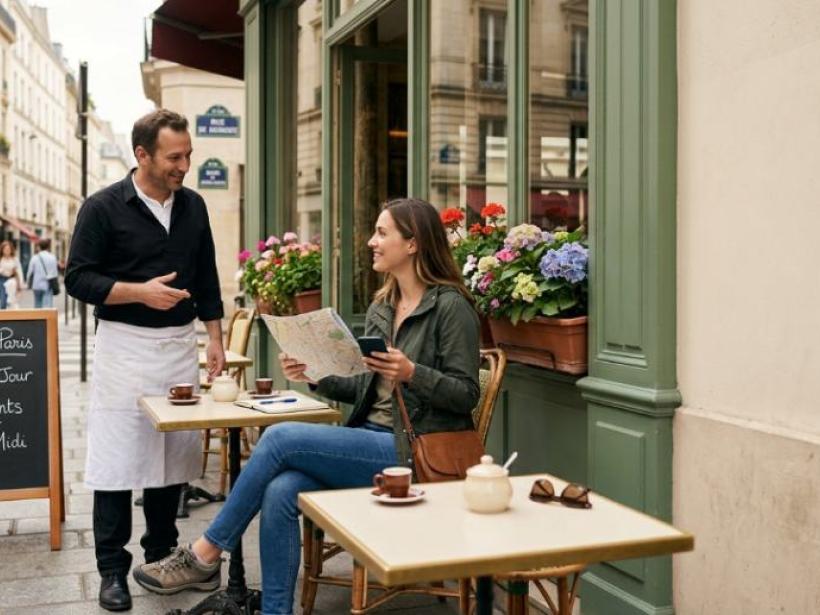

A useful French travel phrase gets you help fast. That's the whole test. It doesn't have to sound correct in a phrasebook, it just has to work on a real person having a long day, whether you're navigating Paris or working through the best places in the south of France. Most lists online skip that distinction, which is why so many tourists show up having memorized the wrong things.
The phrases that matter most cover four situations. Greeting someone. Asking for help. Asking a price. Finding a bathroom. Learn "excusez-moi," "parlez-vous anglais," "combien ça coûte," "où sont les toilettes," and "merci beaucoup," and that combination gets most travelers through most days.
What French Phrases Do Travelers Need?
Forget the 50-phrase lists. Most days in France only call for a handful of these, repeated constantly. The same principle applies whether you're learning Greek words and phrases or French ones, a short working set beats a long memorized one.
|
French |
Meaning |
When to Use It |
|
Excusez-moi |
Excuse me |
Getting someone's attention |
|
Parlez-vous anglais? |
Do you speak English? |
Right after the greeting, not before |
|
Combien ça coûte? |
How much does it cost? |
Markets, taxis, anywhere without a price tag |
|
Où sont les toilettes? |
Where's the bathroom? |
Cafés, train stations, museums |
|
L'addition, s'il vous plaît |
The check, please |
Ending a meal without waving frantically |
Why French Sounds Nothing Like Your Phrasebook
Here's the part almost nobody teaches. Learning to say these phrases isn't hard. Recognizing them when a French speaker fires one back at full speed, that's what makes you feel lost standing in a boulangerie.
Spoken French drops syllables constantly. "S'il vous plaît" often comes out closer to "sivouplé." "Je ne sais pas" turns into "chais pas." "Il y a" collapses into "y a." None of that shows up in a phrasebook, since phrasebooks teach the written form, and nobody actually talks like the written form.
That mismatch is why tourists say a phrase correctly, get a fast reply, and then just freeze. Not because their French failed. Because nobody warned them French at native speed barely resembles French on a page. It's the same gap covered in the traveler's guide to Hawaiian words and phrases, spoken language rarely matches the textbook version. Learning three or four contractions beforehand closes that gap faster than cramming ten more phrases you'll rarely say yourself.
The One Phrase That Actually Gets You Help
Here's something most guides won't tell you, maybe because it sounds too small to matter. It isn't. Saying "Excusez-moi, je ne parle pas bien français" before you ask anything changes the whole tone of the exchange. It signals effort, and French service workers tend to respond to effort more than fluency.
Skip straight to "parlez-vous anglais" without that first line, and it can land as a demand instead of a request. Rarely the intent. Still the effect. Order matters more than any phrase list wants to admit.
I watched this happen at a pharmacy in Lyon. One traveler asked "do you speak English?" outright, no French at all, and got a short, clipped answer back in French. Minutes later, another opened with that same broken French line, apologized for it, then asked her question in English. Slower reply. More patient. The pharmacist even switched to English halfway through. Same question, same gap, wildly different outcome.
Tu or Vous: Which Should You Use?
Use "vous" with strangers. Always. It's the formal "you," and defaulting to it costs nothing. Switch to "tu" too early, with a waiter or shopkeeper, and it can read as overly familiar.
A few situations where the line gets blurry:
- Talking to someone clearly younger than you in a casual setting, like a hostel common room
- Chatting with a local your own age who's already switched to "tu" first
- Anywhere involving children, where "tu" is standard
Getting this wrong once won't ruin your trip. Most French speakers just answer in "vous" until you catch on.
The French Quote Everyone Misquotes
"Voyager, c'est vivre" (to travel is to live) shows up on postcards and travel blogs constantly, usually credited to Hans Christian Andersen. Only half true. Andersen wrote in Danish, not French, and the line "At reise er at leve" is his. The French version is a popularized translation, not something Andersen actually wrote or said.
Still a nice phrase to know. Just don't repeat the Andersen attribution to a French speaker who happens to know their literary history.
What Most Phrase Lists Get Wrong
Most lists optimize for volume, not usefulness. France welcomed a record 102 million international visitors in 2025, up from 100 million the year before, three out of four from elsewhere in Europe. That's a lot of tourists leaning on the same 20 memorized phrases, which is exactly why locals in busy areas tune them out.
Memorizing more phrases isn't wrong, exactly. It's just not where the real gap sits. Say fewer things, in the right order, and actually catch what comes back. The same logic holds for Portuguese phrases for travelers too, fewer words spoken well outperform a long list recited stiffly. You'll get further than someone who knows twice as many words and freezes the second French comes at normal speed.