
What do official travel advisories say about Ecuador in 2026
Several governments advise extra caution for travel to Ecuador in 2026. The US State Department rates Ecuador Level 2: Exercise Increased Caution (January 2026). It warns about crime and civil unrest and tells travellers not to go within 20 km of the border with Colombia, where drug trafficking and kidnapping risks are higher.
The UK Foreign Office (FCDO) advice (February 2026) matches the American stance. It flags the coastal provinces of Esmeraldas, Guayas and El Oro as places where violent crime is more frequent. The Australian Smartraveller service (early 2026) advises exercising a high degree of caution overall and reconsidering travel to the northern border zone.
None of the three advisories recommend avoiding the country entirely. All three consider the Galápagos Islands, the central highlands around Quito and Cuenca, and the main tourist routes in the Oriente safer. Trouble concentrates in specific border and coastal pockets, not across the whole country.
Which parts of Ecuador are safe for tourists
The Galápagos Islands are the safest part of Ecuador. Violent crime is almost unheard of. Petty theft is rare because the islands are isolated and most visitors move in organised groups. Watch your bag on busy ferries and at the main dock in Puerto Ayora, but the risk is low compared with any mainland city.
On the mainland, Cuenca stands out as the most relaxed city for travellers. Street crime concentrates around the bus terminal and the Feria Libre market rather than the historic centre where you will spend most of your time. Quito is edgier. Pickpocketing and phone snatching are common on the Trolebús, in the Mariscal neighbourhood at night and around the Teleférico entrance. The newer parts of town north of Parque La Carolina are calmer during the day.
- The Galápagos Islands have minimal crime; your main concern is sunburn and sea sickness on day boats.
- Cuenca rewards a calm pace: walk the river paths, keep your phone out of sight at the market and take a taxi after 22:00.
- Quito requires street smarts: use the Ecovía rather than the Trolebús, stick to groups in Mariscal and avoid empty streets after dark.
- The coastal strip from Salinas to Olón is busy with Ecuadorian holidaymakers; theft from the beach while you swim is the recurring problem, so leave valuables at your accommodation.
- The Amazon basin around Tena and Coca is safe in practical terms: crime against tourists is rare, but remoteness means you need a reputable guide and a working satellite communicator.
Safety in Ecuador varies by region. A week in the Galápagos followed by a few days in Cuenca keeps your risk low. Quito and the coast are perfectly manageable if you move like a local: nothing in your back pockets, a cheap phone for the street and a taxi after sunset.
Which areas should travellers avoid
Станом на березень 2026 року Держдеп США та FCDO Великої Британії позначають червоним кольором кілька зон, куди туристам їхати не варто. Це не означає, що вся країна небезпечна, але ці регіони справді мають підвищені ризики, пов'язані з організованою злочинністю та наркотрафіком.
Основна рекомендація зводиться до простого правила: уникайте провінцій уздовж колумбійського кордону на півночі та кількох прибережних міст, де діють злочинні угруповання.
Ось конкретний перелік зон, які офіційно не рекомендовані для відвідування:
- Провінція Есмеральдас на північному узбережжі, включно з містом Есмеральдас та кордоном із Колумбією. Тут фіксують високий рівень насильницьких злочинів, викрадень і вимагання.
- Провінція Карчі на півночі, особливо прикордонна зона біля мосту Румічака. Через неї проходять маршрути контрабанди, і присутність озброєних груп робить пересування ризикованим.
- Провінція Сукумбіос на північному сході, зокрема райони Лаго-Агріо та Пуерто-Франсіско-де-Орельяна. Тут діють наркокартелі, трапляються випадки викрадень іноземців.
- Південна частина провінції Гуаяс, поза межами Гуаякіля. Сам Гуаякіль має безпечні туристичні райони, але околиці міста та сільська місцевість на південь від нього є зоною активності банд.
- Провінція Ель-Оро на південному заході, біля кордону з Перу. Тут високий рівень пограбувань і діють організовані злочинні групи, що контролюють нелегальний видобуток золота.
Якщо ваш маршрут пролягає поблизу цих зон, перевірте актуальні попередження на сайті вашого міністерства закордонних справ перед виїздом. Ситуація може змінюватися, і локальні обмеження іноді запроваджують без попередження.
Is public transport safe in Ecuador
Intercity buses are the main way to get around and daytime travel on reputable companies is generally safe. Stick to operators that run from official terminals in Quito (Terminal Quitumbe and Terminal Carcelén) and Guayaquil, where you buy tickets at a counter instead of on the street. Keep your daypack on your lap or between your feet, never in the overhead rack, and do not put anything valuable in luggage stored in the hold. Night buses carry more risk of opportunistic theft and occasional hold-ups on remote stretches, so plan long journeys to arrive before dark.
Taxis hailed on the street are the least safe option. Use a ride-hailing app such as Uber, Cabify or Didi instead. The app records the driver, the car and the route, which deters most trouble. Before you get in, check the number plate against what the app shows and ask the driver to confirm your name. In smaller towns where apps do not operate, ask your hotel or hostel to call a trusted radio taxi and agree the fare before you set off.
- Book intercity bus tickets at the terminal counter, not from touts outside.
- Choose daytime departures and well-known companies such as Transportes Ecuador or Cooperativa Loja.
- Use Uber, Cabify or Didi in cities and always match the plate before you get in.
- Keep your bag on your lap and never store valuables in the hold or overhead rack.
- Ask your accommodation to call a radio taxi where apps do not work.
What are the most common scams and how do you avoid them
Street-level scams in Ecuador are rarely violent, but they are frequent enough in Quito, Guayaquil and around major bus terminals that you should know the patterns. The US State Department advisory valid in early 2026 notes that petty crime and distraction theft are the main risks for visitors. Most incidents involve two or three people working together to divert your attention while another person takes your bag or phone.
Taxi scams are the most reported problem. A driver may claim the meter is broken and demand an inflated flat fare, or take a deliberately long route. Always use a licensed yellow taxi with an orange registration sticker on the windscreen and agree on the fare before you get in. A better option is to book through a ride-hailing app, where the price is fixed and the driver is traceable.
- A stranger spills something on your clothes, then offers to help clean it while an accomplice picks your pocket. Refuse all help and walk away immediately.
- Someone “finds” a dropped wallet or ring and offers to share the contents, which is a setup for a shakedown when the supposed owner appears. Do not touch the item and keep moving.
- A person poses as a plainclothes police officer and demands to check your passport or wallet, often near a bus station. Real officers will not demand cash or valuables on the street. Ask to go to a police station and never hand over your wallet.
- An unofficial “tour guide” approaches you at a landmark with a convincing story and a laminated ID card. Book guides only through your accommodation or a registered agency and check credentials before paying anything.
- A restaurant or bar overcharges you by adding items you did not order to the bill, a practice locally called “la caleta.” Check every line on the bill before paying and keep a rough tally of what you consumed.
- An ATM helper offers assistance and swaps your card or watches you enter your PIN. Use ATMs inside banks during daylight hours, cover the keypad with your other hand and decline all help.
Is Ecuador safe for solo female travellers
Ecuador is a viable destination for solo female travellers who take the same precautions they would in a large European city. Street harassment in the form of hissing, comments or honking is common in Quito and Guayaquil, though physical contact is rare. Ignoring the attention and walking on without engaging is the standard local response and works for visitors too.
At night, use a ride-hailing app rather than hailing a taxi on the street. Uber and DiDi operate in Quito, Guayaquil and Cuenca, and the fare is fixed before you get in. When booking accommodation, pick a place with a 24-hour reception and recent reviews from other women travelling alone. Hostels in the Mariscal area of Quito are social but the surrounding streets feel less secure after dark, so budget for a short taxi ride back.
Dress norms vary by region. On the coast and in the Galápagos, shorts and vest tops attract little notice. In highland towns like Otavalo or Riobamba, women tend to wear trousers or longer skirts, and dressing a little more conservatively helps you blend in. A wedding ring, real or inexpensive, can discourage persistent questions about whether you are travelling alone.
Frequently asked questions
Is Quito safe at night?
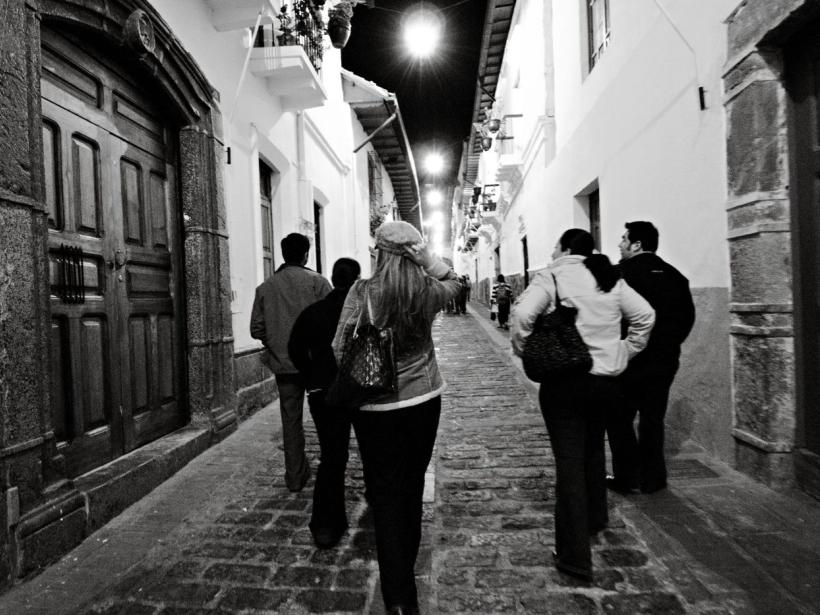
Yes, in the right neighbourhoods. La Mariscal has plenty of bars and restaurants but also a reputation for late-night petty crime, so take a registered taxi or an Uber after dark. The historic centre is well-policed during the day but empties out at night, so it is wiser to explore it in daylight.
Do I need any special vaccines for Ecuador?
Routine vaccines plus hepatitis A and typhoid are standard advice. Yellow fever vaccination is recommended if you are heading to the Amazon basin, and some countries require proof of it if you arrive from Ecuador. Check with a travel clinic at least four weeks before you go.
Can I drink the tap water in Ecuador?
No. Tap water is not safe to drink anywhere in the country, including Quito and the Galápagos. Stick to bottled or filtered water, and use it for brushing your teeth as well. Most hotels and restaurants use purified water, so ice in established places is generally fine.
Is it safe to travel overland from Ecuador to Peru or Colombia?
The border with Peru is calmer and the crossing at Huaquillas is used by long-distance buses, but keep an eye on your luggage and avoid arriving after dark. The Colombian border is a different story: the UK FCDO and US State Department both advise against all travel within 20 kilometres of it because of drug-related violence.
Photo: DΛVΞ GΛRCIΛ, Pexels (Pexels License)