
How Should I Structure Three Days in Paris?
Group your days by neighborhood to avoid spending half the trip on the metro. The city is compact, but crossing from the Eiffel Tower to Montmartre and back eats up an hour each way if you do not plan ahead. A practical split is to dedicate each day to two or three adjacent arrondissements and walk between most sights.
Day one covers the historic core along the Seine, from the Île de la Cité through the Marais to the Louvre. Day two moves west to the Eiffel Tower, the Champs-Élysées and the museums in the 8th and 16th arrondissements. Day three shifts north to Montmartre and the less polished corners of the 9th and 10th, where Parisians actually live. This keeps daily travel under thirty minutes and leaves room for a long lunch or an unplanned detour.
- Day one: Île de la Cité, Notre-Dame, Sainte-Chapelle, the Marais, Louvre (evening slot).
- Day two: Eiffel Tower, Arc de Triomphe, Palais de Tokyo or Musée d’Orsay, Saint-Germain-des-Prés.
- Day three: Montmartre, Sacré-Cœur, Canal Saint-Martin, Belleville for views and local food.
What Are the Must-See Sights on Day One?

Start your morning at the Louvre. Enter through the Carrousel du Louvre shopping center entrance instead of the main Pyramid to skip the longest security line. You will not see everything, so pick one wing. The Denon wing holds the Mona Lisa and the Winged Victory, and two hours inside is enough for a first visit before museum fatigue sets in.
Walk west through the Tuileries Garden toward Place de la Concorde. The gravel paths lead you past the octagonal pond and the Orangerie museum in about fifteen minutes. From the obelisk, continue straight up the Champs-Élysées. The avenue climbs gently for just over a mile to the Arc de Triomphe. Climb the 284 steps to the roof terrace for a view that lines up the Eiffel Tower with La Défense.
- Buy Louvre tickets online for the 9:00 a.m. slot and use the Carrousel entrance on Rue de Rivoli.
- Rent a green Vélib' bike at the Tuileries station and cycle up the Champs-Élysées bike lane instead of walking the whole avenue.
- Climb the Arc de Triomphe at sunset; the terrace faces west and the city lights switch on as you watch.
- Take Metro line 6 from Charles de Gaulle-Étoile to Bir-Hakeim for the classic iron-lattice bridge view of the Eiffel Tower.
- Book Eiffel Tower summit tickets for 9:30 p.m. to see the hourly sparkle from inside the structure itself.
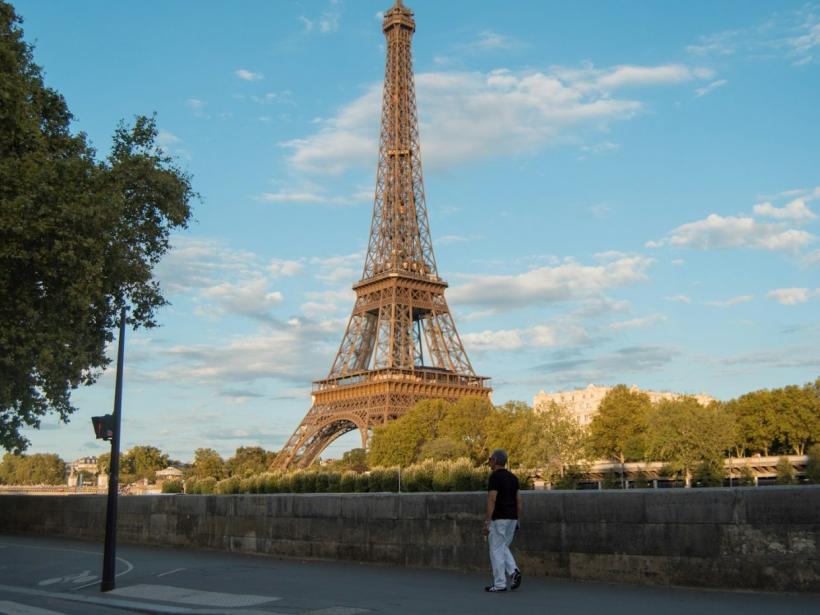
End the day across the Seine at the Trocadéro esplanade. The evening light hits the tower straight on, and the carousel below adds a quieter backdrop than the crowded Champ de Mars. A crepe stand near the Palais de Chaillot stays open late if you skipped dinner.
What Should I Do on Day Two?
The second day shifts to the Left Bank and the islands, moving at a steadier pace than the opening sprint. Start at the Île de la Cité to see the restored exterior of Notre-Dame. The square in front gets crowded by mid-morning, so aim to arrive by 8:30am for a clear view of the flying buttresses and the new spire.
A five-minute walk brings you to Sainte-Chapelle, a thirteenth-century chapel built to house relics of the Passion. The real draw sits on the upper level: 15 stained-glass panels that read like a comic strip of the Old and New Testaments. Book a timed entry ahead of your trip, as the line for walk-up tickets often stretches past an hour. Afterward, cross the Petit Pont into the Latin Quarter. Rue de la Huchette and its side streets are packed with gyro stands and tourist menus, but a short detour to Rue Mouffetard rewards you with a genuine market street where students and locals buy cheese and bread.
Walk off lunch in the Luxembourg Gardens. You will spot the green metal chairs scattered around the octagonal pond, the Medici Fountain tucked in the northeast corner, and the orchard of espaliered apple trees. Late afternoon, head toward the Seine near Pont des Arts and follow the quays west as the light softens. A sunset walk from Pont Neuf to the Eiffel Tower takes roughly an hour at a relaxed stride, passing the Louvre courtyard and the gilded Pont Alexandre III.
How Do I Spend the Last Day in a Less Touristy Way?

Start the morning in Montmartre before the crowds arrive. Walk up the hill around 8:30 AM to see Place du Tertre almost empty and the Sacré-Cœur steps with only a handful of locals passing by. The side streets off Rue des Abbesses have a real neighborhood feel, with boulangeries opening early and the scent of fresh croissants filling the air.
After descending the hill, head to the Musée de la Vie Romantique in the 9th arrondissement. The museum sits at the end of a cobbled alley, housed in a former artist's residence with a small garden where you can pause for tea. Entry to the permanent collection is free, and the rooms preserve the 19th-century atmosphere of George Sand's literary circle without the museum fatigue that larger institutions can cause.
Spend the evening in the Marais, where the rhythm shifts from sightseeing to simple wandering. Rue des Rosiers and the streets near Place des Vosges stay lively but feel local, with bookshops, falafel counters, and small courtyards that open unexpectedly. A practical plan for a less touristy final day:
- Arrive at Montmartre by 8:30 AM and walk the back lanes above Rue Caulaincourt before the tour buses park.
- Visit the Clos Montmartre vineyard on Rue des Saules, a working plot hidden behind a gate that opens for scheduled tours on select days.
- Walk down through the 9th arrondissement to the Musée de la Vie Romantique and spend an unrushed hour inside and in the garden.
- Take the metro to Saint-Paul station and explore the Marais courtyards, including the Hôtel de Sully garden and the Village Saint-Paul antique dealers.
- Grab a falafel on Rue des Rosiers and sit in Place des Vosges as the evening light hits the brick facades.
- End the night with a short walk along the Seine from Pont Marie to Pont Louis-Philippe, where the riverbank quietens down after sunset.
What Are the Best Transport Tips for a Short Trip?

Buying a Navigo Easy pass at any metro station ticket machine saves you from fumbling with single-use paper tickets. The card costs a small one-time fee. You load it with a carnet of 10 rides or a daily pass. Tap it on the purple validator at the turnstile. Keep it away from coins and phones, which can demagnetize the chip.
On a tight schedule, the metro covers long distances fast. The real time-saver is often your own two feet. Many core sights on the Right Bank sit within a 25-minute walk, and surface-level strolls connect neighborhoods in a way the underground network cannot. Use the metro for two or more stops and walk the rest. The Batobus river shuttle stops at nine piers along the Seine and works as a scenic shortcut between the Eiffel Tower, Notre-Dame and the Jardin des Plantes. It is slower than the metro but eliminates staircases and gives you a moving view of the city. You sightsee while you travel.
- Grab a Navigo Easy pass from the purple ticket machines and load a carnet of 10 rides to avoid queueing at every station.
- Walk between attractions that sit within two metro stops of each other, such as the Louvre and the Marais, to save time and discover side streets.
- Check the Batobus schedule at batobus.com and board at any pier when your feet need a rest and your next stop sits along the river.
- Keep your Navigo Easy card in a separate pocket from your phone to prevent the chip from failing at the turnstile.
- Ride metro line 1 for quick east-west hops across the Right Bank, since it is fully automated and runs frequently even on Sundays.
- Skip buses during weekday rush hours unless the route takes you directly to a single destination without transfers.
Which Tickets Should I Book Before I Arrive?
Several major attractions sell out weeks in advance, especially during peak season. Booking ahead locks in your preferred time slot and lets you skip the longest queues. The official websites are the safest way to buy. Third-party resellers often add steep fees without real value.
The Paris Museum Pass covers entry to over 50 museums and monuments, including the Louvre, the Arc de Triomphe, and the Sainte-Chapelle. You still need a free timed reservation at the busiest sites even with the pass. For a three-day trip, the 48-hour pass often works better than the 96-hour one. Cluster your museum visits on days two and three.
- Eiffel Tower summit tickets sell out a month ahead on the official toureiffel.paris site. Book as soon as your dates are firm.
- Louvre timed entry must be reserved via ticketlouvre.fr. The Museum Pass alone will not get you in without a slot.
- Sainte-Chapelle and the Conciergerie share a booking portal at sainte-chapelle.fr. Afternoon light through the windows is spectacular.
- Catacombs of Paris tickets go fast, often two weeks out. The official site limits group sizes, so book directly at catacombes.paris.fr.
- Palace of Versailles requires a separate reservation outside the Museum Pass. Use the official chateauversailles.fr site for the Passport ticket with timed entry.
Frequently asked questions
Can I really see Paris in three days?
You can see the major landmarks and get a genuine feel for the city's rhythm. The itinerary focuses on one area per day, so you are not rushing across town. You will miss some museums and neighborhoods, but you will leave with a clear sense of the city rather than a blur of metro rides.
What is the best area to stay for a short visit?
The 1st, 4th, 5th, or 6th arrondissements put you within walking distance of most sights on this itinerary. Staying central costs more, but it saves you roughly an hour of transit each day. If you prefer a quieter neighborhood with good metro links, the 11th near Bastille works well.
Is the Paris Museum Pass worth it for three days?
It depends on how many museums you plan to enter. If you visit the Louvre, Sainte-Chapelle, and the Arc de Triomphe rooftop, the pass roughly pays for itself. The real value is skipping the ticket queue at busy sites, though you still need a time slot reservation at the Louvre.
How do I get from Charles de Gaulle airport to the city center?
The RER B train is the most reliable option and takes about 35 minutes to Gare du Nord. Fixed-rate taxis cost more, but they are straightforward if you have luggage and arrive late at night. Avoid unlicensed drivers who approach you inside the terminal.
Photo: Flora, Unsplash (Unsplash License)