
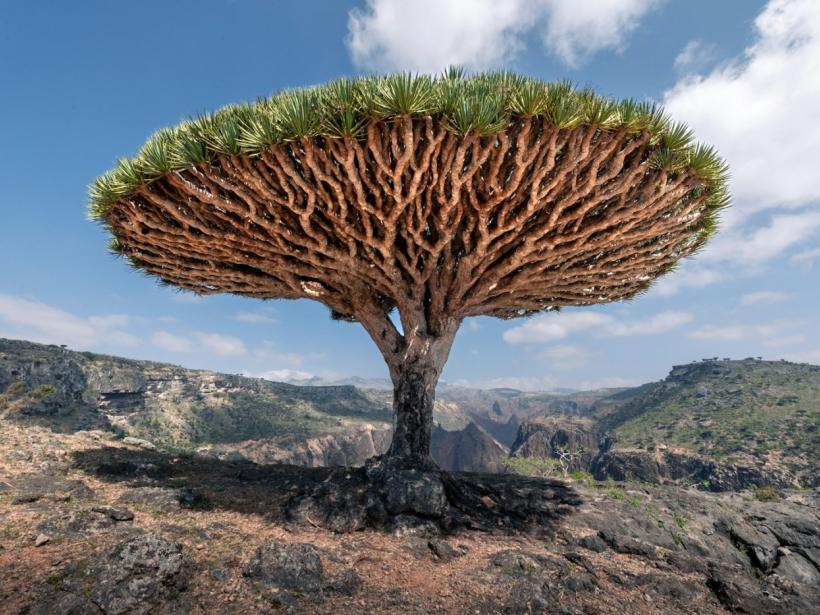
Why visit Socotra Island and how do you get there?
Socotra Island delivers a landscape that feels borrowed from another planet, anchored by the dragon blood tree, a mushroom-shaped oddity that bleeds crimson sap when cut. The island broke away from mainland Africa roughly six million years ago, and more than a third of its plant species exist nowhere else on Earth. You walk among bottle trees swollen with water, limestone cliffs that drop into turquoise lagoons, and sand dunes that hum when the wind hits them right.
Getting there requires patience. Air Arabia flies twice a week from Abu Dhabi, and Yemenia Airways runs a weekly flight from Cairo. All flights land at the single airstrip near Hadibo, the island's main settlement. You need a Yemeni visa arranged through a Socotra tour operator before you board, because there is no visa-on-arrival facility on the island. Tour operators typically handle the paperwork as part of a package that includes a local guide, ground transport, and camping gear, since independent travel is not permitted under current regulations.
The island's remoteness means every service works on cash, and internet access is sparse. Flights run only from October through May, with the best weather landing between November and March, when daytime temperatures stay comfortable and monsoon winds take a break. Book at least three months ahead because seat availability is tight and permits take time to process.
What makes the Salar de Uyuni a must-see?

The Salar de Uyuni in southwest Bolivia is the world's largest salt flat, stretching over 10,000 square kilometers. During the dry months the surface hardens into a blinding white crust of hexagonal salt polygons that seem to vanish into the horizon. The sheer scale plays tricks on your sense of distance, making it a favorite spot for forced-perspective photos.
The rainy season transforms the flats into a shallow, perfectly still lake that mirrors the sky. Stand on this glassy surface at dawn or dusk, and the line between earth and sky vanishes. Most travelers join a three-day jeep tour from the dusty town of Uyuni, which also takes you past colored lagoons, flamingo flocks, and high-altitude geysers. Book with a local operator after you arrive for a better rate, and check the vehicle has working seatbelts and a spare tire.
- Dry season from May to October gives you firm ground and full access to the islands.
- Wet season from December to March creates the famous mirror effect on the flooded flats.
- Overnight tours include basic salt-block lodgings with no heating and temperatures well below freezing.
- Acclimatize in Uyuni town for a full day before you head out to altitudes above 4,500 meters.
Which cave cities can you actually explore?
Several ancient cave cities welcome visitors without the need for a major expedition. Cappadocia in Turkey is the most accessible, with a well-developed tourism infrastructure and direct flights into Kayseri or Nevsehir from Istanbul. Matera in southern Italy is a walkable city of cave dwellings carved into a limestone ravine, easily reached by train from Bari. Vardzia in Georgia is the most remote of the three, a 12th-century cave monastery complex dug into the Erusheti Mountain that requires a long drive from Tbilisi or Kutaisi.
Each destination offers a distinct experience. Cappadocia feels vast and surreal, with entire underground cities like Derinkuyu and Kaymakli open for self-guided exploration. Matera blends ancient cave living with modern comforts, as many of the sassi have been converted into hotels and restaurants you can experience firsthand. Vardzia delivers raw historical immersion, with frescoed chapels and winding tunnels where you climb steep metal staircases installed for visitors.
- Cappadocia lets you walk through multi-level underground cities with ventilation shafts and stone doors still in place.
- Matera feels like a living museum where you can sleep in a renovated cave room and walk the same streets people inhabited for 9,000 years.
- Vardzia rewards the effort with fewer crowds and a dramatic setting overlooking the Mtkvari River gorge.
- English-language signage and guided tours are readily available in Cappadocia and Matera, while Vardzia benefits from hiring a local guide at the entrance for context.
- All three sites involve uneven stone steps and low passageways, so sturdy shoes matter more than fitness level.
When is the best time to visit these destinations?

Good timing makes the difference between a memorable adventure and a logistical headache. Socotra is accessible from October to May, when temperatures settle between 25°C and 30°C and monsoon winds that ground flights from June to September stay away. The island shuts down almost completely during the summer khareef season, so plan your trip outside that window.
The Salar de Uyuni offers two distinct experiences. Visit between May and November for cracked, crystalline salt polygons stretching to the horizon under clear skies. December through April brings a shallow water layer that turns the flats into a giant mirror, but heavy rain can block access to Incahuasi Island and remote sections of the salt pan.
Cappadocia and Matera work as year-round destinations, though spring and autumn deliver the most comfortable walking conditions. Summer heat in Cappadocia regularly exceeds 35°C, while Matera’s limestone alleys amplify July and August temperatures. Winter brings occasional snow to both regions, adding a quiet, dramatic layer to the stone architecture but sometimes closing hiking trails.
How do you pack for extreme or remote landscapes?

Packing for places like Socotra, the Salar de Uyuni, or Cappadocia’s cave cities means preparing for harsh sun, rugged ground, and very limited access to shops. Pack for three non-negotiables: sun protection, sturdy footwear, and a self-sufficient medical and snack kit. On Socotra, you cannot pop into a pharmacy for blister plasters or sunscreen, so bring everything you might need from day one.
On the Uyuni salt flats, the real challenge is the blinding reflection off the white salt crust. Standard sunglasses are not enough. You need polarized lenses with full UV400 coverage and a wide brim hat that stays put in the wind. For cave cities and Socotra’s limestone plateaus, a pair of broken-in hiking shoes with a Vibram sole will save your ankles on uneven, sometimes slippery stone. Leave brand-new boots at home.
A practical kit for these landscapes:
- A high-SPF, reef-safe sunscreen stick that will not leak in your bag and is easy to reapply without a mirror.
- A lightweight, long-sleeved shirt and pants in a UPF 50+ fabric to cut sun exposure without overheating.
- A compact first-aid kit with antiseptic wipes, blister bandages, and any prescription meds in double the needed quantity.
- A headlamp with fresh batteries for caves and for Socotra campsites where generators shut off after dark.
- A reusable water bottle with a built-in filter, because bottled water is scarce on the island and unreliable on the Altiplano.
- A dry bag or heavy-duty ziplock to seal electronics and passports against fine salt dust and sudden desert rain.
Are these trips suitable for solo travelers?
Each destination suits independent travelers, but the experience differs sharply. Socotra requires a fixed tour with a licensed operator. You cannot wander alone, yet the small group size and shared camp meals create a ready-made social circle. Solo travelers often bond with the handful of other people on the same itinerary.
Matera is the easiest of the three to explore alone. Public buses connect the modern town to the sassi district, and you can book a cave hotel or wander the stone stairways without a guide. The Salar de Uyuni sits in the middle. You can base yourself in Uyuni town and join a shared jeep tour, which pairs you with other travelers for a day or three days. Going truly solo with a private driver costs far more and strips away the communal element that makes the salt flats memorable.
Safety depends more on preparation than on the place itself. Socotra is remote, so travel insurance with evacuation cover is essential. Uyuni sits at high altitude, and altitude sickness can hit anyone regardless of fitness. Matera is a walkable European city with standard precautions. In all three cases, a working offline map and a local SIM card solve most problems before they start.
Frequently asked questions
Do I need a guide on Socotra Island?
Yes. Independent travel is not permitted on Socotra. You must book a package through a licensed tour operator, which will include a guide, transport, and often camping gear. This is strictly enforced to protect the fragile environment.
Can you see the mirror effect on the Salar de Uyuni year-round?
No. The mirror effect happens only when a thin layer of water covers the salt flat, typically from late December to early April. During the dry season from May to November, the surface is hard, white salt crust with geometric patterns, which is stunning in a different way.
Which cave city is easiest to reach from a major airport?
Matera in Italy is the most accessible. You can fly into Bari and take a direct train or bus that takes roughly 90 minutes. Cappadocia requires a flight to Kayseri or Nevsehir and a short transfer, while Vardzia in Georgia involves a longer drive from Tbilisi or Kutaisi.
Is it safe to travel to these places?
All three destinations are generally safe for tourists who follow local advice. Socotra is remote with very basic medical facilities, so comprehensive travel insurance is essential. The Salar de Uyuni sits at high altitude, so you should spend a day or two acclimatizing in Uyuni town before joining a tour.
Photo: Andrew Svk, Unsplash (Unsplash License)