
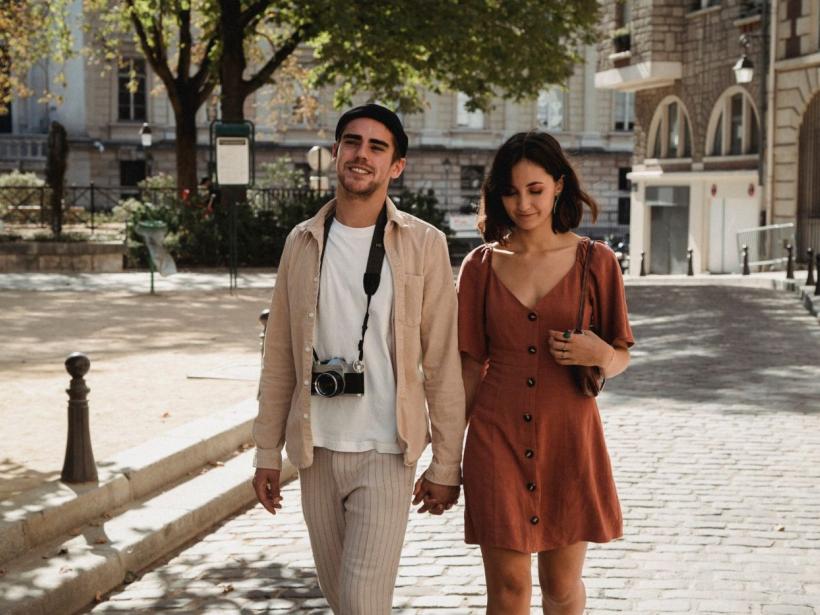
Where can we find a quiet garden for a picnic away from the crowds?
The Square du Vert-Galant sits at the very tip of the Ile de la Cite, a triangular wedge of green that most visitors walk right past. You reach it by descending the stairs behind the equestrian statue of Henri IV on the Pont Neuf. The park is named for the king’s nickname, a nod to his romantic reputation, and the space still lives up to it. Weeping willows dip toward the water on both sides, and the bench at the point gives you a front-row seat to the Seine parting around the island. The river traffic, the Louvre across the water, and the absence of any playground or major monument keep the crowds away.
A sunset picnic here works best with a few practical moves. Pick up a baguette, cheese, and a half-bottle of wine from the shops on the Rue de Buci, a five-minute walk away in the 6th arrondissement. Arrive about an hour before sunset to claim one of the wooden benches along the western tip, though a blanket on the sloping lawn works just as well when the ground is dry. The willows provide shade until the low sun slips under them, and the stone quay below the park lets you dangle your feet above the water once you finish eating. Stay until the riverboats switch on their lights and the Pont Neuf glows against the darkening sky.
Which neighborhood feels like a secret village for a slow afternoon stroll?

Butte-aux-Cailles in the 13th arrondissement holds onto a village rhythm that the rest of Paris left behind a century ago. Cobbled lanes like Rue des Cinq Diamants and Rue de la Butte-aux-Cailles wind past low-rise houses draped in wisteria, and you will hear more neighborhood chatter than traffic noise.
Start at Place Paul-Verlaine, where the art-deco Piscine de la Butte-aux-Cailles draws swimmers year-round with its arched red-brick facade and naturally warm spring-fed water. From there, wander without a map toward the intersection of Rue de l’Espérance and Rue Michal, where a cluster of street-art murals by Miss.Tic and local collectives covers entire gable walls. The real pleasure is stopping for a glass at a corner wine bar like Le Sputnik, where tables spill onto the pavement and the pace of service tells you nobody is in a hurry.
- Wear flat shoes: the cobbles are uneven and steep in places.
- Visit on a weekday afternoon when the laundromats and bakeries set the tempo.
- Look for the fresco at 36 Rue de la Butte-aux-Cailles, a changing canvas painted by residents.
- Skip dinner reservations and graze instead: pick up cheese at the market on Place de la Commune then settle onto a bench.
- Bring a sketchbook or a camera with no agenda; the neighborhood rewards slow attention.
Is there a covered passage that still feels like old Paris?
Galerie Vivienne, tucked between the Palais-Royal and the Bourse, is one of the few 19th-century passages that has kept its original soul without turning into a chain-store corridor. The glass canopy throws a soft, even light onto the mosaic floor, and the quiet hum of a few independent shops replaces the street noise outside. You can spend a good hour here just walking slowly, peering into windows, and forgetting what century you are in.
The bookshop Librairie Jousseaume sits at the corner of the passage and has been selling volumes since 1826. Its wooden shelves climb to the ceiling, and the owner will usually let you browse undisturbed. Picking out an old postcard or a second-hand paperback together feels more personal than any souvenir shop on the boulevard. A few doors down, the wine bar Legrand Filles & Fils offers a glass of something crisp if you want to pause and talk without a waiter rushing you.
Visit on a weekday morning, right after opening, to have the mosaic floor almost to yourselves. By lunchtime the passage fills with office workers cutting through, and the quiet spell breaks. Rainy afternoons work too, when the glass roof sings with the downpour and the place turns into a warm, dry cocoon.
What are the most romantic canal-side walks that locals actually use?

The stretch of Canal Saint-Martin between République and the Bassin de la Villette is the after-work promenade Parisians actually use. Start at the double lock near Rue Dieu, where the iron footbridge gives you a front-row view of boats slowly rising and falling in the chambers. The black metal and churning water of the lock become a quiet spectacle you can lean on the railing and watch without a ticket.
Walk north along the cobbled quay under the plane trees. You will pass the Pont Tournant, a small swing bridge that opens for barges, and a series of arched cast-iron footbridges that frame the water perfectly for photos. People sit on the banks with a bottle of wine, a bag of cherries, and their feet dangling over the edge. The only sounds are the occasional clang of a bridge and the murmur of conversation.
About halfway up, stop at Le Jemmapes on Quai de Jemmapes for a sidewalk aperitif. The terrace sits right on the water’s edge, and a glass of crisp white wine or a kir comes with an uninterrupted view of the canal and the lock-keepers at work. From here you can continue to the Bassin de la Villetre, where the water widens and the evening light turns the old warehouses gold. The full walk takes under an hour, and it feels miles away from the city’s formal monuments.
Where can we hear live jazz in a tiny, intimate cellar?
The stone-vaulted cellar at 38Riv in the Marais is the place. The room sits below street level on Rue de Rivoli, its low arched ceiling and bare stone walls pulling the music into a warm, immediate sound. You are never more than a few feet from the musicians, and the lack of amplification for most sets means you hear the instruments as they actually resonate in the space.
Shows run Thursday through Saturday, typically with two sets per night. Booking a table through their website is essential: the room holds fewer than fifty people and fills up fast, especially for the late set. The early set tends to be more relaxed. The late one draws a livelier crowd and often stretches past midnight.
The absence of a stage makes it feel like a local secret. The trio or quartet simply sets up in the corner, and the audience sits close enough to see the keys move. There are no velvet ropes and no minimum drink spend beyond your own tab. Order a glass of wine, settle in, and let the acoustics do the work.
What viewpoints give us a skyline without the Eiffel Tower queues?

The rooftop of the Centre Pompidou gives you a sweeping panorama where the rooftops and chimneys of the old city stretch toward the distant Sacré-Coeur. The terrace is spacious, the crowd stays downstairs in the modern art museum, and the view feels like a calm, elevated stroll above the city noise.
For a more communal, free-spirited scene, the steps of Sacré-Coeur at dusk are hard to beat. The basilica itself glows, the sky shifts to deep blue, and the whole city spreads out below you like a living map. Bring a simple snack, claim a spot on the limestone steps, and let the guitar players and the sunset do the work.
The terrace at the Institut du Monde Arabe on the Left Bank gives you a sleek, modern view of the Seine and Île Saint-Louis in the foreground. It is rarely busy, and the glass panels on the building’s facade filter the light to make the whole scene feel like a quiet, architectural secret.
- The Pompidou rooftop is a ticketed space with a clean, open-air design and a view that emphasizes the dense, historic city center.
- Sacré-Coeur steps are free, busy but not cramped, and the view is more about the vast, hazy distance and the sky’s color shift.
- The Institut du Monde Arabe terrace feels like a hidden balcony, with a closer, more intimate look at the river and the islands.
- At Sacré-Coeur, the best light is the 20 minutes right after the sun dips below the horizon, when the city lights start to flicker on.
How do we end the night at a wine bar that feels like a well-kept secret?
La Buvette, on a quiet stretch of Rue Saint-Maur in the 11th arrondissement, operates with a handful of tables and a long zinc counter lit by flickering candles. The space is tiny, often standing-room only, which forces a shoulder-to-shoulder closeness that feels more like a private party than a public bar. Owner Camille Fourmont curates a rotating list of natural wines, scribbled on a large mirror behind the bar in white marker.
There is no printed menu. You walk up, describe what you like in broad terms (earthy, cold, bubbly, strange), and she pours a glass from a bottle that was likely opened moments before. The food is equally improvised: plates of tinned sardines with good butter, a single perfect burrata, or a slice of terrine cut to order. Locals treat it as a reliable nightcap spot, arriving after dinner elsewhere and staying for one glass that quietly becomes three.
Arrive after 10 p.m. on a weekday to avoid the crush. The bar accepts walk-ins only, and the room fills to capacity within an hour of opening. Bring cash, as the card machine has a temperamental relationship with the thick stone walls. Once you settle in, the absence of music and the low murmur of conversation create a hush that makes the rest of Paris feel very far away.
Frequently asked questions
Are these spots safe to visit after dark?
Yes, the areas mentioned are generally lively into the evening. Stick to well-lit main streets when walking between them, and keep an eye on your belongings as you would in any major city.
Do I need to book these places in advance?
For the jazz club and some tiny wine bars, a reservation is wise, especially on weekends. The parks, passages, and viewpoints are public spaces you can visit anytime without booking.
What is the best time of year for a romantic trip to Paris?
Late spring and early autumn offer mild weather and fewer tourists than the summer peak. Winter can be magical too, with far quieter streets and cozy indoor spots, though you will need warm layers.
Can we walk between these locations or should we use the metro?
Several of these spots cluster in the central arrondissements and are walkable if you enjoy long strolls. For others, a short metro ride or a single bus journey will get you there efficiently.
Photo: Bethany Ferr, Pexels (Pexels License)